Monday, January 11, 2016

Voyaging the House-Stormy Weather

It blew like stink for a few days and I never once had to get up and check the dock lines or anchors.
Breakwater at Sesuit Harbor on the north shore of Cape Cod in the Town of Dennis.

Back in the Rumor days, we entered St Martin's Simpson Bay Lagoon and motored over to an anchorage between Grand Islet and Witches' Tit.  It was going to blow and I wanted as quiet a place as possible.  We set two anchors much to the complaining of my crew.  That night it blew and boats all around us dragged.  My crew, young son Andrew, said, "Good move dad with two anchors."

Today, the after-storm work is to pick up some deadfall around the property and go back to work on the house.  

Tuesday, January 5, 2016

Voyaging the House-Boats and Costs

This web site has a good summary of the cost of preparing to cruise and cruising.  The yacht Sundowner is a Westsail 32, 19,000 lbs displacement.  By comparison, the Aphrodite 101, also 32 feet long, is 7,000 lbs displacement.

This site is well organized.  http://sundownersailsagain.com/costs/  Sail on Sundowner!

Inspires one to wonder just how to accomplish a voyage aboard a much smaller boat.  All of the earliest voyaging yachts were pretty small.  Captain and Mrs Crapo sailed TransAtlantic on a 20 foot whaleboat, "Centennial" Johnson on a 20 foot dory, and then the Rob Roy story of a 20 foot yawl.  Tillicum, a log canoe sailed by the Venturesome Captain Voss went around the world in a 38 footer that was pretty narrow.  Slocum's Spray was 38 feet.

In the modern era we have small boats sailed by Lin and Larry Pardy, Patrick Ellam and Colin Mudie, Shane Acton, Chay Blythe, and John Guzzwell, to name only a few.

Interesting voyages are made on small boats.


Averisera, idle on Cape Cod

Monday, January 4, 2016

Retire and Go Sailing-Static vs Dynamic

In a house, one is static.  Life moves past one in the form of visitors and seasons.  Travel, of course, is dynamic.  It is secondary to the static life at home.

On a voyaging yacht, life is dynamic.  One moves dynamically from place to place viewing the place as a static event.  Stay long enough in one harbor and the situation changes to mimic housing.

Retire and Go Sailing-Cross Training

Live ashore and cross train?  Sounds like something that happens at the gym.  Live aboard and cross train.  Sounds like learning to do one another's jobs.  When voyaging, redundancy is critical and that means we cross train to be able to replace one another.

When we sail at night, often during deliveries to and from distance double handed races, one of us is asleep below and the other on deck working the yacht.  There are "below" jobs and "on deck" jobs.  When the occur is not just a function of who is best at the job.  It is more a function of who is available.

Tuesday, December 29, 2015

Voyage the Yacht-The Galley

The perfect boat discussion usually is centered around sail area to displacement ratios and designer/builder characteristics.  How about the galley and provisions stowage?  Very important stuff, food.  No food, no cruise.

Along the same lines as the cost of cruising, cooking during a cruise is going to be similar to the way you do it at home.  There are two big differences:  dry storage space (cabinets and shelving) and cold storage (refrigerators and freezers).  The smallest apartment or house has more stowage than almost any cruising yacht a couple can easily handle.

The resource:  http://theboatgalley.com/pressure-cookers/  Pressure cookers are the best.  Lots of great tips.  The author of this blog covers the subject well.

Reducing the galley discussion to simple terms:  
The drawers and cabinets must hold the utensils and cookware you use and the foods you cook.  
Fundamentals:
Pots and pans must fit on the stove burners when the yacht is sailing, heeling.  I prefer saute pans and pots without long handles.  A small stove top pressure cooker is almost essential.  However, if the pots are hard to stow and don't fit the stove, they are useless.

You know how you cook.  Now, you can start looking for the most suitable galley propelled by the appropriate sail area to displacement ratio.

Here are some views of two similar plain vanilla 38 footers of about 16,000 pounds displacement.  The galley is small with little workable counter space unless the navigation table is called into action.    I had a similar setup on the C&C 38 Mk 3 I skippered for years.  Using the navigation station as a surface is practical in port, count on it.


 Space behind the settee cushions may be suitable for some galley equipment.  The first thing to notice is that the storage space is going to need some sort of "lee cloth" to keep items from falling out.  this is a typical retrofit.  The PFDs demonstrate the amount of space available.


When you start voyaging your house, little things make the biggest differences.  House or boat, same, same.  Ashore, we can nip off to the nearest big box store for another set of shelf systems and set it up in the basement.  The rule of available space:  Parkinson's Law.

Thursday, December 24, 2015

Retire and Go Sailing- The Boat

The perfect house?  The perfect boat?

As a result of reading a lot of blogs and forums about "the perfect boat" I did some thinking in an effort to reduce the answer to something simple and straightforward.  Here's what I came up with and two images that demonstrate the point.

A lot of time is spent at anchor so that should be comfortable.  Some hull shapes are quieter than others.  Pick a comfortable shape where the transom overhang does not slap the water.  The images of two models of C&C 38s follows.  The older model has a nicely sloping counter the newer one has a flat counter that slams hard in even the gentlest chop.  I have sailed both types and like them both.

A jarring "slap" with each passing wake or chop makes sitting in the cockpit or sleeping forward unpleasant.  Since half your day is either lounging in the cockpit or sleeping, the slapping issue is very important.  The rest is really about taste.
A superb resource for sail boat details and drawings is www.sailboatdata.com

A reference for boat relative speed, another article for later, is www.phrfne.org

This shape rides gently at anchor and under sail

Four cruisers rafted with a racer

Wednesday, December 23, 2015

Retire and Go Sailing

Retire and go sailing.  A great idea from my point of view.  Some people actually do it.  A lot more talk about it in terms of can it be afforded and what is the perfect boat or how do I start?

I like this blog:  http://www.frugal-retirement-living.com/index.html

A very pretty Bermuda 40 yawl all tricked out for voyaging.  This picture was taken during a training cruise.  The students got a chance to look at the B-40's details and discuss the features.  A lot of learning happens when you go on a training cruise, even if it is just a few days in duration.

There are always a few basic questions as noted above.  There are always a few too-short answers as follow!

Short answers:
The cost of cruising is the same as the cost of doing anything else, it can be as expensive or cheap as you like.  Mostly, the way you live ashore is the way you will live aboard so those costs are going to translate pretty well from house to boat.

There is no perfect boat.  The proof is that when you are out there, you'll see a lot of different boats each with a happy cruiser aboard.  What about the unhappy cruisers?  They quit and it isn't the boat that does it.
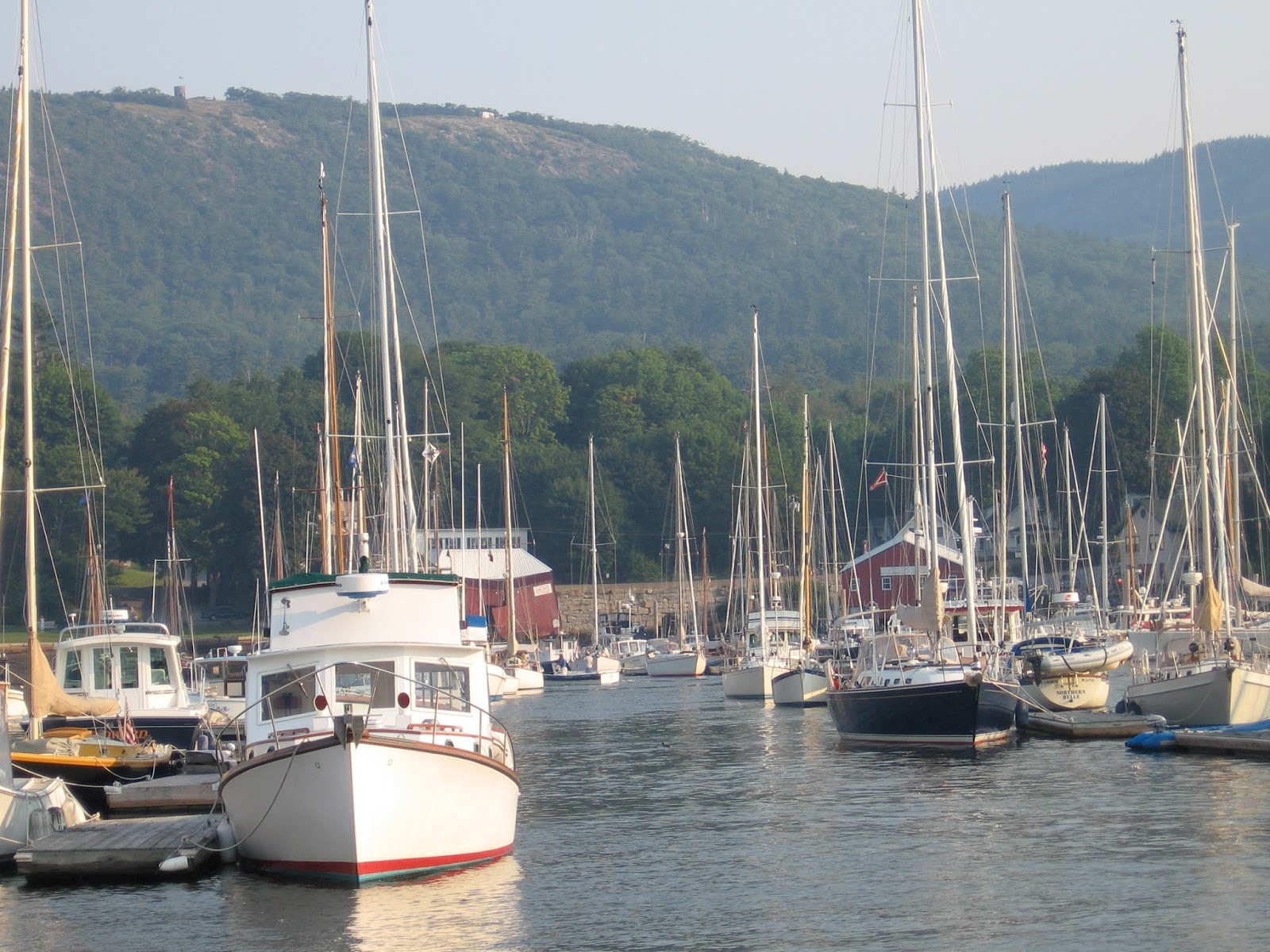
Cruising yachts rafted to pontoons in Camden Maine, Inner Harbor.  Each on a "perfect boat."

Where to start?  Start with sailing school, Take courses up to the most advanced level possible such as:
Maybe charter a few times in a couple of different places on a few different types of yachts.  The instructors, charter captains, and other professionals will provide barrels of useful information.  Sailing with a professional will help the student acquire a library of best practices.

One dinghy has its oars stowed improperly!

Continuing education?  Consider the USCG Captain's license sometimes called the "six-pack."  Even if you do not have the time required for the full license, the course of study and tests will boost your capabilities greatly.  Racing is a practical way to get in some sailing time and improve one's skills.  Two types of races that are really good for cruisers are pursuit races and double handed races.  They don't feature the crazy maneuvering tactics of small boat fleets.  In fact, most of the participants are cruisers trying to improve their boats and the owner/couple's skills.

A Gulf 32 with a new suit of sails finishing well up in the fleet during a large pursuit style race.  Good sails and a clean bottom made a big improvement in the performance of the yacht.