Showing posts with label Cruising Courses and Certifications. Show all posts

Wednesday, December 5, 2018

Voyager Notes: Section 1: Planning a Voyage, an Atlantic Circle

From the ASA's 108 standards, skills 1 and 2


1.Plan a passage across the North Atlantic or Pacific and state the advantages, disadvantages and hazards of various routes, utilizing Ocean Passages for the World, climatic charts, Great Circle plotting charts, plotting instruments, etc.
2.Plot a series of rhumb lines on a Mercator chart to approximate a great circle route.

Our plan is to sail from Newport, RI to Horta, Azores using a 35 foot seagoing sloop.  

The Azores are most of the way across the Atlantic and on the route to Gibraltar and the Med. It is over 2300 nm from New England which is about 16 days at an average speed of 6 knots or 20 days at an average of 5 knots. I'd plan on 20 days!

Let's discuss charts. We will use a Mercator Chart, pilot chart, and a Gnomonic chart. Each has it purpose.

 At the outset, let's make Plan A: the top shows two of the possible planning tracks. On the Mercator Chart, the pictured pilot chart, the great circle route plots as a curve, white pins. The great circle route goes into the cold reaches of the North Atlantic north of the Gulf Stream. The warmer and somewhat longer route is plotted as a curve to the south of the rhumb line. Advantages are warmer water, a fair current, and favorable wind direction and strength. The dark pins mark the route this sailor prefers, Plan A.


Pilot Chart for North Atlantic in June

The catalogue of pilot charts shows average conditions for each month.  Other considerations are things such as hurricane season in the Atlantic, July through November.  Hurricanes are most likely in August through October which makes those poor months for North Atlantic voyaging.  Other oceans have other severe weather seasons.  Seldom discussed is the risk of prolonged periods of calm.  No wind is a severe condition for a sailing vessel.


 A view of the big picture. 


A closer look at the Gnomonic chart comparing the Great Circle Route (straight line with flags) to the straight line on a Mercator chart (curved line marked with pins). The pined route keeps the heading constant at 093 degrees True. On the top chart, our desired route is planned out to be below the rhumb line defined by the blue pins (see above chart). It is longer and more comfortable.

Once we arrive at Horta, Azores, what are we doing next? Aside from cruising the islands, how about another voyage? Maybe an Atlantic Circle? (If you can get the book Atlantic Circle by Kathryn Lasky-Knight, do so. True story about a young couple a long time ago in a small boat and eventually with a little kid.) 

Using pins on the Gnomonic chart, the Atlantic Circle is detailed. The regulator of the trip is the Atlantic Hurricane Season, July through November. One must not be too far west as hurricanes brew off the Coast of Africa. Madera, The Canaries, and Cape Verde Islands  are for lingering until the crossing season starts in late November or early December. A first landfall in Barbados, for example.  That starts the Caribbean cruising circuit which ends somewhere in May with a run to Bermuda and then into home waters off New England.


The Atlantic Circle

Tuesday, December 4, 2018

Voyager Notes: Section 5: Emergencies

From ASA 108 standard, Skills 22-31


Emergency Procedures
22.Describe how to rig a trailing man overboard (MOB) line with an alarm.
23.Describe an alternative method of alerting the crew to MOB situation. State other emergency situations when you should limit the use of this device.
24.Describe what actions should be taken when a MOB is not located on the first pass.
25.Describe how to organize the crew for a routine fire drill.
26.Describe possible methods of jury rigging a vessel in the event of dismasting and what course should then be assumed.
27.Describe proper actions to be taken after a vessel has been struck by lightning.
28.List essential survival items to be kept in a standby kit in the event the vessel must be abandoned offshore.
29.Describe additional useful survival and rescue items.
30.State the dangers that might be encountered in a small life raft at sea.
31.List safety equipment that should be carried in addition to Federally required items.


The biggest emergency most of us can imagine is man overboard. Therefore, the most important safety precaution we can undertake is to prevent a man overboard from occurring. This starts with jacklines, safety harness and tether. The jacklines must be rigged so that they limit the distance a crew mcan "fall" to within the lifelines. Once over the side, your ability to be recovered is greatly decreased.


Short tether and a jackline near the centerline of the vessel are the two starting points for the discussion. The other habit to form is to travel on the windward side of the yacht. Secondaily, use the windward jackline to limit a crew's opportunity to get outside the lifelines.


The jackline is yellow and runs from bow to stern. A tip from sailing pal, Mike, is to twist the jackline making it easier to pick up. Granted, this is a narrow flush deck sloop and working on the leeward side while clipped in to windward jackline is easy, maybe easier than on a wide boat with a cabin trunk. The principal idea is valid, stay inside the lifelines.

On a recent delivery of a 43 footer, a jackline was rigged along the cockpit centerline. This allowed crew to clip in as they can up the companionway. It would have been almost impossible to have been swept out of the cockpit and over the side.


"Stay inside the fence!" as sailing pal Joe states.


22. Describe how to rig a trailing man overboard (MOB) line with an alarm.


The idea here is that if you fall overboard you will be able to swim quickly to the trailing line, grab hold and the line tension will sound an alarm or trip a device that will steer the boat to a stop. This writer is skeptical. I prefer a discussion about how to avoid getting to the other side of the fence.


Dodge Morgan sailed a big sloop, American Promise around the world in the 1980s. He was tethered to the boat, slipped and fell into the water astern of the yacht. It wasn't until the yacht luffed, for no apparent reason, that he was able to clamber aboard. He was holding onto the boat the entire time. The drag from his foulies and boots was enormous, he reported.


23. Describe an alternative method of alerting the crew to MOB situation. State other emergency situations when you should limit the use of this device.


I have often thought an air horn in the cockpit to be a good idea for alerting the crew below of an emergency on deck. Perhaps a whistle signal can be the non-emergency alarm.


24. Describe what actions should be taken when a MOB is not located on the first pass.


A. Keep trying. B. Enlarge the search circle. C. If possible, get someone up the rig for a look around.


There is no substitute to keeping the crew on deck and inside the lifelines.


25. Describe how to organize the crew for a routine fire drill.


Fire is a terrifying event. The first step is prevention which is part of preparation. Know where a fire might start and have a routine inspection of that area. On two occasions that I have seen a fire start, both were electrical short circuits that did not trip a breaker for some reason. Once the current was shut off, the fire was quickly extinguished. 


The crew must know the location of fire extinguishers and how to use them. The other aspect is to know the most likely place for a fire to start and how to fight that fire. For example, engine room fires are fought by flooding the space through a specially located opening in the engine box. Usually, the opening is located in the companionway step area.


A view of a companionway stairway showing the opening for a fire extinguisher nozzle. To use: remove the plastic plug, insert the firex nozzle and pull the trigger. This will flood the engine room with extinguishing material and put out the fire. As soon as possible, maybe even before using the firex, turn off the electric circuits and shut off the fuel flow. Don't open the engine room until you are certain the fire is out.

Turn the vessel downwind to minimize airflow over the fire.


26. Describe possible methods of jury rigging a vessel in the event of dismasting and what course should then be assumed.


Dismasting comes with a large set of immediate concerns. Among the immediate concerns are crew injury, hull puncture, and the change in behavior of the yacht which will make all work on the yacht much more hazardous.


First, account for the crew and stabilize any injuries.

Second, decide if the mast can be brought aboard or cut loose. Either way, a plan must be formulated quickly.
Finally, the crew must be extraordinarily cautious moving around the mastless yacht as it will roll much more sharply that before the rig came down. Injury after the mast is down are more common than before the mast fell. 

So much depends upon where the rig failed as to what can be jury rigged. Masts are heavy. A Tayana 37 mast was hard for eight men to carry a short distance. The same was true of a Tartan 40 mast I assisted with recently. Heaving either up on deck and securing it in a rolling seaway is virtually impossible. 


The method for cutting a rig loose is something to think through in the preparation stages. Tools such as hammers, drifts, hack saws and powerful bolt cutters are needed. 


27. Describe proper actions to be taken after a vessel has been struck by lightning.


First thing is to avoid a lightning strike by sailing away from lightning. Sometimes that is impossible so prepare your vessel by mitigating the risks from a lightning strike. The principal thing is to ground the yacht as completely as possible. While studies have shown that grounded yachts are not less likely to be struck, they suffer less damage than ungrounded yachts.

If a yacht is struck first check the bilges to determine if any through hulls are affected. The next step is to check for short circuits and the fires they may start. Turn off the electrical system until that inspection is complete. 

Studies by a university in Florida report that strikes to yachts occur most often in coastal waters. The Atlantic Intracoastal Waterway is known to be a place where some yachts are struck each year. It is observed that one never sees a large steel offshore buoy with evidence of a lightning strike 

A couple of anecdotes follow. A 30 racing sloop with an ungrounded rig was struck while at its mooring and surrounded by larger yachts with taller rigs. The 30 footer sank quickly due to perforation of the hull. Surrounding boats showed no damage. A 33 sloop that is grounded was in the vicinity of a strike and the electromagnetic field (EMF) melted some wiring insulation causing short circuits, blown fuses, a blown alternator but no other damage. A large sloop that was hauled out at a boatyard was struck and severely damaged. No other nearby yachts were affected. It is thought that the hauled yacht's grounding system was "disconnected" by being out of the water. 

Abandoning Ship! 

Rule 1, Step up into the liferaft.

Three American sailors, Steve Callahan, Dougal Robertson and William Butler wrote good books about being in a liferaft and what it takes to survive. Sailors think they plan ahead and when the time comes there is no time to revise the plan and get a "do over." Life raft and ditch kit must be carefully thought out and assembled based on the persons most likely to be aboard the raft. In contemporary times, technology has diminished the likelihood of a disastrous outcome to abandon ship. As with so much about sailing, the individuals are the determining factor.

There are training programs that put people into a liferaft under controlled conditions. Comments from several people who have been through those programs report that panic is not uncommon. Practical experience is more than just useful. The human element is never minimal.


28. List essential survival items to be kept in a standby kit in the event the vessel must be abandoned offshore.

A satellite phone or SPOT type global emergency beacon to back up the EPIRB. During the preparation phase, register and test the EPIRB. 


Since dehydration, heat stroke and/or hypothermia are major risks, water, shade, and warmth are essential components to survival. They must take precedence in the ditch kit.


29. Describe additional useful survival and rescue items.

Keep the life raft working. "The repair kit has to be bigger and better than the one supplied," is a takeaway from reading the aforementioned authors. 


30. State the dangers that might be encountered in a small life raft at sea.

Capsize! Puncture!


As a salesman for a liferaft company stated, "you never spend any time in a life raft and wish you'd spent less on the equipment."


31. List safety equipment that should be carried in addition to Federally required items.


Yachts are required to have flares and life jackets. Other items could include immersion suits, global communication devices, signal mirrors, fishing gear, high visibility materials such as smoke, dye, distress signal kite, and plastic sheeting (sea streamer) are examples.


Not related to abandon ship are such devices as a drogue or sea anchor. The ability to heave to is essential. A drogue is also the best device for managing a lost rudder. You won't sail as quickly but you will go in the desired direction.

Reference materials and manuals are part of a yacht's safety equipment. Be able to solve problems be referring to expert writing. Even if you are an expert mechanic, a reference book will support your work. Same is true for so many other demands of a voyage.


Wednesday, August 29, 2018

Sail Training Tips for ASA or US Sailing


Thoughts about the sailing school certification courses known as:
ASA 103: Cruising
ASA 104: Bare Boat Chartering
ASA 106: Advanced Coastal Cruising

US Sailing Cruising Course
US Sailing Bareboat Chartering Course
US Sailing Coastal Passage Making

What else does the sailing student need to know? My thoughts follow.


Pictured: some ocean sailing yachts in coastal cruising environments. The question is, what is a cruising yacht and what differentiates a coastal yacht from a coastal passage maker from an ocean voyager. Aside from a few physical characteristics of yachts, it is really just how the sailors use the vessels.

Physical characteristics: cruisers are self righting and self rescuing and have some sort of accomodation for life aboard. By this we mean, a galley, head, and berths. The terms self righting means that the boat will right itself if tipped very far over, maybe masthead in the water. Self rescuing refers to a cockpit that drains into the sea and not the interior. In general, cruising yachts are very difficult to sink. Oh, they will when the hull is breached.

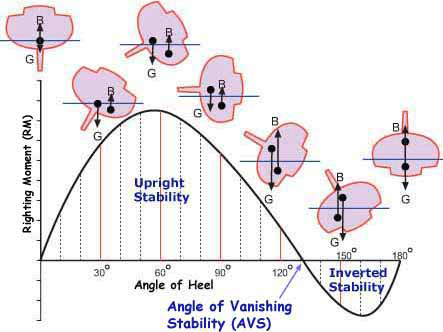
Stability is described with the GZ curve. https://www.sailboat-cruising.com/gz-curves.html
Basically, at what angle of heel will the vessel not recover. From the article in 
https://www.sailboat-cruising.com/ 
Definitely a terrific sailing/voyaging blog.
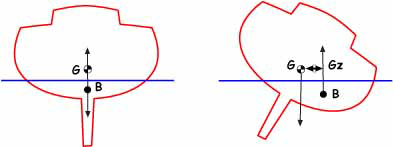
The Gz curve illustrates the relationship between the three key factors that determine the boat's static stability:~
  • the Centre of Gravity (G) through which gravity exerts a downward force equal to the displacement of the boat, and
  • the Centre of Buoyancy (B), being the centre of the underwater volume of the boat, whose upward thrust counteracts the effect of gravity acting through G, and
  • the horizontal distance (Gz) between G and B.
The location of G is fixed, unlike B which changes as the boat heels and the immersed section changes shape.
As the Centre of Gravity and the Centre of Buoyancy initially move apart and then converge, so the length of Gz - the righting lever - increases and decreases.
This relationship between heel angle and righting moment governs the shape of the Gz curve and defines the boats static stability.
Artwork by Andrew Simpson
A useful site for comparing one boat to another is:  http://www.tomdove.com/sailcalc/sailcalc.html
We use this calculator to compare a know boat with an unknown. For example, we have an Aphrodite 101. How does it compare to a similar sized Pearson Flyer. Two numbers get our attention, the motion comfort value is low and the capsize ratio is high.

Enough about boats...

What about the sailors? 

The levels of certification offered by sailing schools generally is a measure of where the student is in terms of seamanship and boat handling. Sailing schools have their curricula. This piece is about the material sailors should know that's not on the list of "skills taught."